
Interviews with Indian Masters
Ali Ahmad Hussain Khan: Weaving A Cosmic Rug
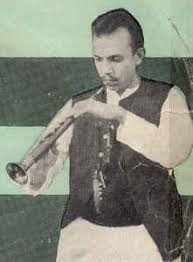
Ali Ahmad Hussain Khan
Four real-life musical angels have visited The City of Angels in the past month. First Pandit Jasraj, then Shivkumar Sharma and Zakir Hussain, and now, Ali Ahmad Hussain, India's great shehnai genius. It is very late, and I will not go into a detailed technical analysis of Ali Ahmad's performance last night of Rageshri, Malkauns, and a bhajan. To give you some idea, there were tears streaming down the faces of people seated on the floor in the front row. I was seated towards the back where one could still see and hear perfectly. During the music, I had a vision of Ali Ahmad's shehnai weaving a cosmic rug of miraculous design that lifted off the floor, audience onboard, and headed out towards the soft radiance of the full moon. Ahmad Abbas, Ali Ahmad's son, is well on his way to becoming another giant of the shehnai, possessing his own individual sound and style. We were also graced by the profound musicality and sensitivity of Subhen Chatterjee's tabla, which was a joy to hear. The course of Western music was forever changed in 1960, when John Coltrane, deeply influenced by the supreme shehnai artist, Bismillah Khan, and Ravi Shankar, released his landmark recording of My Favorite Things, a Richard Rodgers-Oscar Hammerstein composition. Beginning with this LP, Coltrane focused on developing what was termed "modal jazz." Coltrane used the soprano saxophone instead of his usual tenor saxophone for My Favorite Things, in part because the soprano saxophone has a sound somewhat similar to the shehnai. Before shifting to composition, I was primarily an improvising saxophonist, and have a special appreciation for the shehnai. There were, of course, earlier recordings of modal jazz by the Dave Brubeck Quartet, and the Miles Davis Quintet, featuring Coltrane, in addition to other instances, but My Favorite Things was the moment when Coltrane, together with McCoy Tyner, Elvin Jones, and Steve Davis, truly implanted Western musical consciousness - jazz, rock and contemporary classical - with his revolutionary synthesis of Indian classical music, jazz, blues, gospel, and African music. Everyone was grateful to the Sri Aurobindo Center, and Popatlal and Kalpana Savla for the opportunity to experience Ali Ahmad Hussain's artistry in such a beautiful and intimate setting. - Michael Robinson, June 2001, Los Angeles
© 2001-2006 Michael Robinson All rights reserved
Composed after midnight, following the performance. Comments about John Coltrane were added in 2006. Michael Robinson is a Los Angeles-based composer and writer (musicologist).
|