Charukeshi In Lahaina: An Evening With George Harrison
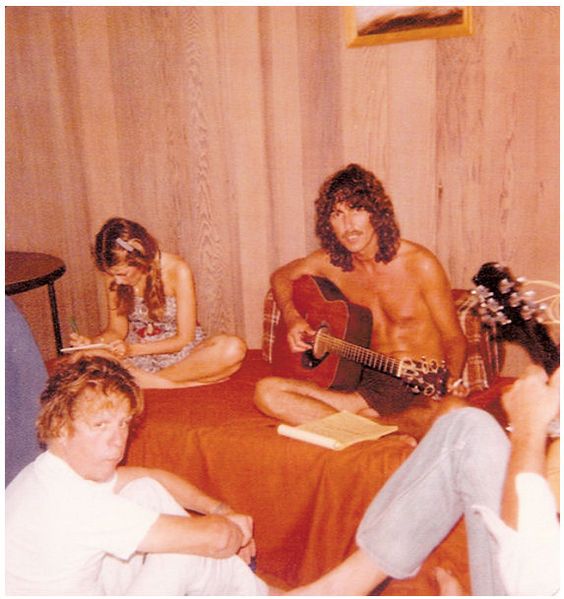
Bob Longhi and George Harrison. Longhi introduced Harrison to Michael Robinson.
These recollections and thoughts were written the week following George Harrison's tragic passing in November 2001. Subsequently, I added some commentary about the music of the Beatles.
From across the restaurant he appeared youthful, tall and thin, and his stride was unusually smooth, almost seeming to glide across the floor. Now he was sitting across the table, and I was struck by hundreds of little lines on his face, suggesting an extraordinary map of experience.
He expressed enthusiasm for a raga he was currently studying, and was planning to create a song based upon it. What attracted him to Raga Charukeshi, the twenty-sixth mela of the South Indian classical music grouping of ragas, was the juxtaposition of a major modality in the purvanga (lower tetrachord) with a minor modality in the uttaranga (upper tetrachord). Before singing the melodic shape of Charukeshi for me, the Englishman hesitated, remarking that maybe it wasn't a good idea for him to share this musical knowledge with another composer who might steal his idea. But that was only a half-serious thought, and he went ahead, and sang the swaras of Charukeshi. The resulting sound brought a shock of recognition to my ears, and I thought to myself that his voice was rather good. After all, he had held his own singing shoulder-to-shoulder with John Lennon and Paul McCartney!
In-between living in my native New York City, and my current home in Los Angeles, I spent one year in Kapalua, Maui. I loved jogging on the hillside at noon alongside the Captain Cook pines, their intense dark green hue contrasted by the deep azure sky. From my home, I could see the Pacific, and the island of Lanai while composing. My part-time job playing Cole Porter songs and such on a white, baby grand Yamaha piano in an upscale clothing boutique was within walking distance.
It was a Saturday evening in January 1990, and my girlfriend and I decided to have dinner in Lahaina. Soon after sitting down to eat, we learned that George Harrison was visiting the restaurant owner, Bob Longhi, at his home a few miles down the road. George and Bob were good friends, and George had dedicated the song, Soft-Hearted Hana, to his buddy in the album credits for the the 1979 album titled George Harrison. However, it is not my style to chase after celebrities, and so I mused that maybe if Bob brought George to the restaurant there might be a chance to meet him.
"Soft-Hearted Hana" is for Bob Longhi dedication by George Harrison.
Credits detail from 1979 LP album titled George Harrison.
Nonetheless, I kept my eyes peeled to the upstairs entrance throughout the meal, and my heart began to race when someone who seemed to fit Harrison's image appeared, but it turned out to be a false alarm, and my hopes faded. Less than a half-hour later, another similar figure appeared, but this time the person was with Bob Longhi, and as if in a dream, it was George Harrison, garbed in jeans, and a long-sleeved denim shirt over a T-shirt with a Magritte reproduction. My exultation turned to despair when they headed for the back room, out of our view. Then, miraculously, they reappeared, and sat down at a table against the back wall of our section in direct view. George was seated together with Bob, the legendary quarterback, Fran Tarkenton, who was also a friend of Bob, and two other men I did not recognize.
Bob Longhi, Stevie Nicks and George Harrison (Maui)
During all this, we were joined by two friends, one of who had spent time with George and his wife in Hana. Knowing my reverence for the Beatles, she asked if I would like to meet Harrison. I wanted to, of course, but there were no empty seats at George's table, and I didn't want to walk up like some annoying autograph seeker, not to mention that I was somewhat intimidated. So we sat there stealing glances, and after a few drinks, my inhibitions were subdued. When I noticed one of the men leaving George's table, the friend who knew him said, "Let's go!" and I found myself following her in a dream-like state. When we arrived at the table, Bob immediately came to my rescue, introducing me as a composer, whereupon George graciously invited me to sit down at the empty seat directly across from him, gesturing with the open palm of his hand. The restaurant was quite loud, and so we both leaned forward, our faces about a foot apart, as I began a conversation with one of my musical idols. So close that George opened humorously with: "You had garlic for dinner!" (It was a side dish of spinach sautéed in garlic.) Embarrassed, I apologized, while struck by his unusually dark eyes, but Harrison reassured: "It's OK; I like garlic."
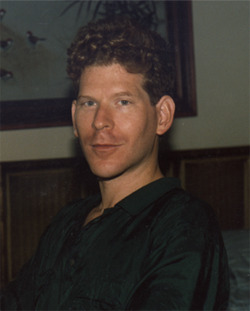
Michael Robinson in his Kapalua studio the month he met George Harrison.
Michael still has this green silk shirt and the red silk shirt worn the night he met George.
The cocktail waitress came over, and George ordered tea, explaining that he was already highly intoxicated (knowing Bob, undoubtedly extremely potent ganja), and could not handle an alcoholic drink. Feeling very English, I ordered the same. Later on, I ordered a Brandy Alexander, which drew a curious stare from George, as this was a favorite drink associated with John Lennon and the Beatles.
Responding to George's question about my own music, I told him how I composed music for a computer and sound module. He explained that his personal preference was for live musicians, and that while he had made use of electronic instruments in the past, he was no longer interested in them. He said that most recently there had been some frustrating experiences with drum machines. When I told him how excited I was about the possibilities for percussion music using a computer and sound module, he replied, "You must be a better man than me!" (Eventually, I decided upon the instrumental name Meruvina for the combination of hardware and software I compose for, finding it more descriptive and fitting.)
I was disappointed, though not completely surprised, to hear about George's current disillusionment with electronic music. During his time with the Beatles, they made powerful, innovative use of electronic instruments on some of their most famous recordings, including Revolver, Sergeant Pepper, Magical Mystery Tour, and the White Album, not to mention their groundbreaking work with four-track recording. I understand that George made extensive use of electronic music on some of his early solo projects, but I am not yet familiar with those recordings.
The Beatles' use of electronic instruments, and electronic effects were always seamlessly organic, rather than gimmicky slap-ons. Their masterful four-track recordings possess a coloristic subtlety and variety that leaves me groping for comparisons, and the only thing that comes to mind are nothing less than the orchestrations of Gustav Mahler.
My in-depth study of Indian classical music did not begin until 1994, but I was already fascinated with Indian classical music, and it had begun manifesting a major influence on my music. Knowing of George's involvement with Indian music and Ravi Shankar, I asked him why Western classical music, while being of timeless artistic quality, nonetheless reflects a particular time and place, while Indian classical music sounds as contemporary today as it must have sounded hundreds, and even thousands of years ago. "Because its better," he replied without hesitation, voicing his belief that Indian classical music was a more profound art form that deserved much wider recognition. This was the moment that inspired him to sing the arohana and avarohana of Raga Charukeshi for me.
We continued talking uninterrupted for at least two hours, and the roar of the restaurant faded into the background. During the conversation, George revealed that his favorite music for Western strings was the accompaniment to I Am the Walrus, and that his favorite guitarist was, by far, Jimi Hendrix. I responded by expressing my admiration for the artistry of Johnny Winter. To this day, I believe that Winter is unsurpassed when at his best. George met these comments with a stony stare, and I took that to mean he disagreed with me, but perhaps he simply was unfamiliar with Winter's playing, or was surprised by the musical experience my choice indicated. When I expressed great admiration for his own playing, he confessed with graceful modesty that he had "no idea" what he does while playing the guitar. Harrison is easily among the very best rock guitarists along with Page, Winter, Allman, Berry, Clapton and Hendrix among others. George's modest comments reinforce some similar statements he has made, including the idea that the further advanced one becomes, the less that person knows, and, "If you don't know where you're going, any road will take you there."
Rap was big at the time, and George voiced disdain for the genre, remarking that "Tone-Deaf" would be a more appropriate name for the artist, Tone-Loc. I personally thought Tone-Loc's Wild Thing was terrific, but kept my opinion silent.
When the subject turned to exercise, George revealed that he had gone swimming earlier in the day, but wasn't in shape. After noting that he appeared in excellent condition, Harrison quipped back: "That's because I'm nineteen!"
At one point, George said that if we had been in science class together, I would be the honor student, and he would be the one who accidently causes an explosion. It was intended to be self-depreciating, and a compliment towards me. In fact, I had very little interest in science and math while in school, and I was the last person in the world to become involved with computers. For me, the computer is simply an extension of my imagination; it allows me to realize my musical impulses.
Turning to Bob Longhi at another juncture, Harrison enquired about the name of my father, and without skipping a beat, Bob retorted in his typically direct and matter of fact manner: "Mr. Robinson."
When I brought up the subject of surrealistic art, a personal favorite, inspired by his Magritte T-shirt, George seemed unfamiliar, or uninterested discussing the artists associated with that period, so I quickly dropped it.
Harrison peppered our conversation with humorous observations and jokes, providing a refreshing diversion from the esoteric musical and philosophical subjects we focused on. Together with his immersion into Hindu philosophy, he was clearly a street-wise person who had been catapulted into the upper echelons of world society.
At one point, Harrison mischievously teased me about my preference for computer instruments with his famous accent, asking if one gets as horny with computer music as you do playing rock and roll. My music absolutely has a sensual dimension, but I knew he was joking, and laughed out loud.
Security was definitely on his mind, and George, very deliberately, asked me to accompany him to the restroom, where I stood guard in case he was besieged by fans. Looking back, I think he had a premonition. (I also may have had a premonition some years later when I visited Maui one week before the 1999 attack on Harrison in England. Shortly after arriving in Lahaina, I felt compelled, completely out of the blue, to make every effort I could to persuade Bob to invite George to visit us, mostly so we might discuss my use of ragas as a basis for composition, and Indian classical music in general. I had been to Maui every winter after our meeting in 1990, but this was the only time I felt a strong desire to meet with George again. My entreaties were unsuccessful - Bob didn't wish to impose upon his friend - and the awful attack that greatly weakened Harrison occurred a few days later.) Later on, when a rude man approached our table, and asked, "Are you George?" he replied, "No", with emphatic emphasis, causing the fan to wander away confused.
There was a cover rock band playing that night, and people in the restaurant were ignoring them, giving no response at the end of each song. Harrison revealed something of the surrealistic nature of his mind when he said the restaurant should play recorded applause through strategically located speakers. Beyond that, George said he didn't understand why the band continued to play when they were being completely ignored by the restaurant patrons.
Harrison apologized several times during our extended conversation for being overly intoxicated, but he seemed fine and completely lucid to me. I was surprised by how animated and talkatave he was because I had imagined he would be shy and reserved. Obviously, that was a mistaken notion, but perhaps he was more outgoing than usual due to his being high.
One regret I have from that evening is how I failed to respond when George asked me if I wanted to go walking down Front Street with him to "Look at the T-shirt shops!" stated with the enthusiam of a young boy. Somehow I couldn't believe I was really hearing this invitation, and I also wrongfully thought that Bob would not approve of me wandering off with his friend who didn't visit Lahaina very often. So the opportunity passed, and we continued our conversation. Later on, George asked me to drive him to his hotel, which I gladly would have done, especially because it was over an hour away, and would have given us more time to talk, perhaps even stopping at a bar along the way, but, most regretfully, I was unable to comply. Simply listening to the car radio with him, and sharing thoughts about the music playing would have been thrilling!
Some years after meeting George, I had matured both musically and personally, and I found myself agreeing with John Lennon that the Beatles were human beings, and not gods. The music of the Beatles is perfect, powerful and enchanting, but even within the genre of rock it might be argued that they never matched the raw sensuality of Led Zeppelin and The Doors, for example. But that is beside the point. For instance, within the American popular song tradition, Rodgers and Hart have musical characteristics distinct from those of Cole Porter or Jerome Kern, and in jazz, the same is true if you compare the tenor saxophone styles of Ben Webster, Stan Getz and John Coltrane.
Perhaps one famous rock musician, whose name I didn't catch, put it best when asked on the radio who he listened to for inspiration. Even though the year was 2001, he replied, "Well, there's a group out of Liverpool, and they play a song called Eleanor Rigby. The rest of us play the blues!" I agree that overall, the Beatles are on another level.
To draw an analogy between the exquisite singing voices of the Beatles with the culinary arts of India, John was sweet, salty and pungent, Paul was sweet, and George was sweet, pungent and sour. Together they achieved a new variety of musical perfection, and that applies equally to their instrumental abilities, including the joyous melodic drumming of Ringo, who is rarely given the proper recognition. And let us not forget that there really were five Beatles. It is unlikely that their music would have reached such a high level without the refined musical sensibilities of their producer, George Martin.
It was during a time of pervasive, overpowering influences, including the startling and refreshing new musical form known as rock, sexual emancipation, natural and synthesized drugs, the Vietnam war, and cataclysmic political assassinations, that the Beatles poured out dozens and dozens of immaculate musical gems that rescued the world's spirit from total despair.
Their albums, if viewed as song cycles, surpass the greatest Western classical composers in terms of both content and variety. I do believe the great American popular song writers, like Irving Berlin, Jerome Kern, George and Ira Gershwin, Cole Porter, Oscar Hammerstein, and Richard Rodgers and Lorenz Hart were equally great, but the Beatles songs are unique because only they could perform them. That is a subject worth exploring: Why some composer's songs are conducive to different interpretations, and other composer's songs can only be effectively performed by themselves, with some rare exceptions, of course.
John Coltrane, The Byrds, The Doors, Traffic, the Allman Brothers Band, and the Grateful Dead, among many others, all helped spread some of the sounds of Indian classical music, but it was George Harrison who brought attention to the philosophical basis of Indian music and culture. It is impossible to overestimate the role he played in bringing South Asian concepts to the attention of the West. Without him, it is doubtful that Ravi Shankar, Indian classical music, and traditional music from other cultures would be as prominent in the West as they are today. John Cage is another person who played an important role in introducing Eastern philosophical and artistic concepts to the Western world.
One of my favorite Harrison songs is Love Comes To Everyone, which features a fine Eric Clapton solo, and one of the greatest keyboard solos in rock history played by Steve Winwood. It is puzzling that the album the song comes from, the aforementioned, George Harrison, is so little known. In addition to the breathtaking vocals, instrumentals and over-all feeling of Love Comes to Everyone, the album features the lovely, Here Comes the Moon, which achieves the remarkable task of measuring up as a companion piece to Here Comes the Sun. As noted previously, Soft-Hearted Hana, is also found on this album.
It makes sense that George would be attracted to the double image of the raga I mentioned in the opening paragraph, Charukeshi. One of his greatest songs, While My Guitar Gently Weeps, also presents a blending of major and minor tonalities. Many of Harrison's songs feature a pleasingly disorienting confluence of joy and sadness, simplicity and complexity.
Harrison's singing voice frequently sounds like someone talking, a quality shared by Bob Dylan and Frank Sinatra.
Given George's immersion into Indian culture, has anyone ever remarked upon the coincidence that the name Harrison contains one of the names Krishna is known by: Hari?
The Indian influence on George's music is most beautifully demonstrated in Here Comes the Sun. Groups of 16 beats, the same number of matras found in teentala, the most popular tala in Hindustani music, are divided 3-3-3-3-4 during an instrumental refrain. This reflects simply, elegantly and joyously some of the rhythmic complexities found in the ragas and talas of Indian classical music. The middle vocal repetition takes things a step further with phrases that may be subdivided into 7, 8 and 11 beats or matras. Here Comes the Sun is my favorite example even though some of Harrison's other songs actually use Indian instruments, and something akin to Indian musical forms.
The Beatles' music covers the gamut of the rasas that are the aesthetic basis of Indian classical music. For example: Something for shringara rasa, I Am the Walrus for veera rasa, Eleanor Rigby for karuna rasa, Lucy In the Sky With Diamonds for adbhuta rasa, and Back in the USSR for hasya rasa. There are countless other Beatles songs one could use for examples.
If one was to draw an analogy between the Beatles and the five elements, John would be fire, Paul would be water, George would be air, and Ringo would be earth. Holding it all together is their brilliant producer, George Martin, who would be ether.
It was heart-rending to see recent photographs of Harrison's life-force fading from his face. Hearing the news of his passing, it made me wish he had shared his affliction with the world. Maybe his fans and admirers could have willed a cure by sheer numbers, and global awareness of his life-force being threatened might have had a Gandhi-like effect on a world afflicted with war and hatred.
George Harrison graced the world with his distinctive musical profile. Resonating eternally will be his songs, voice, and guitar playing.
It seems clear to me, despite the fog upon LA, that Harrison created the greatest body of work of all the Beatles after the group disbanded, even with Lennon and McCartney gracing us with breathtaking flashes of their sheer musical genius. I always assumed this was because George's songs with the Beatles were less of a collaborative effort, while Lennon and McCartney were more dependent on each other, and George Martin. But is also makes me wonder if George's contributions to the songs composed by Lennon and McCartney have been greatly underestimated. That said, I should mention, in the context of the Beatles, that John Lennon has always been both my favorite member of the group, and my favorite rock singer period. Paul McCartney sings and plays like an absolute angel. Ringo Starr is rock's most profoundly musical drummer. George Martin's contributions to the musical arrangements, and recording quality of the Beatles albums were indispensable. I am uncertain about the extent of his involvement on the Let It Be album.
Somehow, I never heard the song, All Things Must Pass, until the day after Harrison passed away. This particular performance, which I prefer to the original recording heard months later, took place while being interviewed on VH1 in 1997, and features George accompanying himself on acoustic guitar. The effect is overwhelming. Now I realize it may be the most touching of all his creations. It is one of the most tender, and beautiful love songs of all time, with its heart-stopping evocation of human love and Nature. Hearing the words and music for the first time brought tears to my eyes, both for the beauty of the song, and the lost hope I had to share with George my immersion into the "ocean of raga" he foreshadowed one magical evening in Lahaina...
- Michael Robinson, August 2002, Beverly Hills
Postlude: Eight years after our meeting, I was deeply moved by the Shivkumar Sharma and Anindo Chatterjee recording of Raga Charukeshi. For the first time, I experienced the unique rasa of Charukeshi, and it truly is one of India's most beautiful ragas. After four years of contemplating, and studying this recording from time-to-time, I composed, and released my own composition based on Charukeshi in 2002. Twenty years later, in 2022, I recorded four albums of piano and tabla duets with Anindo Chatterjee.
Some years after this first effort, I turned to Charukeshi again for the Moonrise and Rain-Mist album.
In
December 2004, I had the pleasure of being interviewed by classical
music host, Martin Perlich, on KCSN FM. We focused on my recent 4-CD release, Dhani, a gorgeous, hypnotic morning raga introduced to me by a Hariprasad Chaurasia recording. Dhani also happens to be the name George and Olivia gave their son.
As I was
saying goodbye to Martin, I felt someone else looking at me, which was odd because
we were alone in the studio. Startled, I turned to my right, and there, placed
on the narrow end of a partition wall, was Richard Avedon's famous orange and
green photo image of George from 1967, with the open palm of his right hand raised in Shiva's "fear
not" gesture. Martin and I had discussed Harrison briefly, and I had the
mystical sensation that George was sending a supportive message from beyond!
Michael Robinson is a Los Angeles-based composer, programmer, pianist and musicologist. His 199 albums include 152 albums for meruvina and 47 albums of piano improvisations.Robinson has been a lecturer at UCLA, Bard College and California State University Long Beach and Dominguez Hills.

.jpeg)